Understanding SEO, GEO, and AEO — And How They Impact Your Website
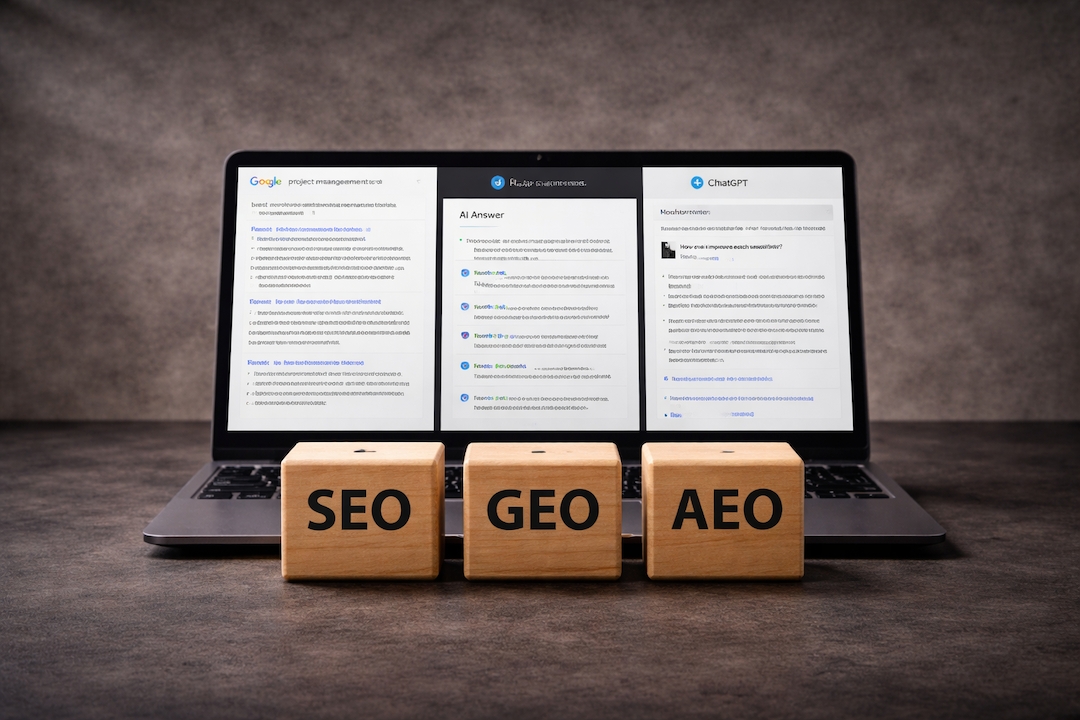
AI search optimization is not a replacement for SEO. Instead, it is an expansion of it. Search has not gone away — but how people search has shifted. A growing number of people now turn to ChatGPT, Perplexity, or Gemini to find answers, compare options, and discover businesses. As a result, if your website is not showing up in those platforms, you are missing a share of potential customers that traditional SEO cannot reach.
At the same time, SEO still works. Google remains the most-used search engine in the world by a wide margin. The mistake is treating AI search as a replacement for what you already have. In other words, the smarter approach is to understand how each channel works and build a strategy that covers all three.
This article explains what SEO, GEO, and AEO each mean, how they differ, and what you can do today to improve your visibility across all of them.
How People Find Businesses Online Is Changing
For most of the internet's history, search meant one thing: typing a query into Google and clicking a link. That model is still common. However, it is no longer the only model that matters.
The Rise of AI-Powered Search
AI-powered tools like ChatGPT, Perplexity, and Google's Gemini now give users direct answers to their questions — without requiring a click to a website. For example, someone asking "what is the best project management tool for a small team" may get a full answer, with a list of options and reasons, before they visit a single webpage.
This changes the game for businesses. In traditional search, visibility meant ranking on page one of Google. In AI search, however, visibility means being cited, mentioned, or recommended within the answer itself. These are different problems with different solutions.
Why This Matters for Your Website
AI search tools do not pull answers from thin air. They draw from the web — from pages that search engines can access and understand (“indexed content”), authoritative sources, and well-structured pages. As a result, the websites that show up in AI answers tend to be the ones that have invested in clear, credible, well-organized content. That is good news, because it means the work of being visible in AI search overlaps heavily with good SEO practice.
However, there are also differences worth understanding. That is where GEO and AEO come in.
The shift in one sentence
Search used to mean Google. Now, however, it means Google, Perplexity, ChatGPT, Gemini, and whatever comes next — and each platform surfaces content in a different way.
SEO: The Foundation That Still Matters
SEO — Search Engine Optimization — is the practice of making your website easy for search engines to find, understand, and rank. It is the oldest of the three disciplines, and it remains the most important foundation for any organic visibility strategy.
What SEO Covers
Good SEO includes technical work — making sure your site loads fast, is easy for search engines to read, and does not have errors that prevent pages from being indexed.
It also includes on-page work — writing content that matches what people search for, using clear headings, descriptive URLs, and well-written metadata (the title and description that appear in search results).
In addition, it includes authority-building — getting other credible websites to link to you or mention your business.
These three pillars of SEO — technical, on-page, and authority — have not changed much in their basics. However, the way they are measured and rewarded has become more advanced over time.
Why SEO Still Works
Google processes more than 8.5 billion searches per day. Despite the growth of AI tools, most people still start their search on Google. For businesses, that means ranking in traditional search results remains one of the highest-ROI activities available. Ignoring SEO in favour of AI search optimization alone would be a mistake.
Where SEO Falls Short
The limitation of traditional SEO is that it only reaches people who go to Google and click a link. A growing segment of searchers — especially those asking complex, research-oriented questions — now get their answers directly from AI tools without visiting a webpage at all. For these users, however, traditional rankings are not enough.
What SEO gets you
Visibility in Google and Bing search results when someone types a query and clicks a link. Still the highest-volume channel for most businesses, however it does not cover AI-generated answers.
GEO: Getting Cited by AI Search Platforms Like Perplexity and Gemini
GEO stands for Generative Engine Optimization — in simple terms, getting your website cited inside AI-generated answers. It is the practice of structuring your content so that AI-powered search platforms — like Perplexity, Google's AI Overviews, and Gemini — cite your website when generating their answers.
How Generative Search Engines Work
Platforms like Perplexity do not show a list of ranked links like Google does.. Instead, they combine information from multiple sources and generate a single written answer. They then cite the sources they drew from. As a result, if your website is one of those sources, it gets mentioned (cited) in the answer — often with a link.
The factors that influence whether a site gets cited are different from traditional SEO. Perplexity and similar tools favor content that is well-structured, clearly written, and from a source that appears credible. In other words, they reward the same things that make good journalism or good documentation.
How to Optimize for GEO
The core practices for GEO overlap with good SEO and good writing. However, a few specific habits make a meaningful difference.
Use clear section headings (H2 and H3 are just the subheadings on your page) that read as complete statements or questions. AI engines use headings as anchors to identify what a section is about.
Open each section with a direct answer to the section's question. Do not bury the point — AI tools scan for the answer at the top of a block.
Define technical terms on first use. Generative engines favor content that is self-contained — meaning a reader (or AI) can understand it without needing extra context.
Include specific, factual statements rather than vague ones. Precise, verifiable claims get cited. Vague ones get ignored.
Link to authoritative external sources. Generative platforms treat outbound links to credible sources as a trust signal.
What GEO gets you
Citations and mentions inside AI-generated answers on Perplexity, Google AI Overviews, and Gemini. Visibility happens inside the answer itself — not in a ranked list of links below it.
AEO: Getting Recommended by ChatGPT and Other Answer Engines
AEO stands for Answer Engine Optimization — in simple terms, getting your business recommended when someone asks an AI tool a question. It is focused on platforms like ChatGPT, Claude, and similar AI chat tools — platforms where users ask questions and expect a direct, helpful response rather than a list of links.
How Answer Engines Differ from Generative Search
The distinction between GEO and AEO is subtle but important. Generative search engines like Perplexity are built around real-time web access — they fetch and cite sources as part of generating their answer. Answer engines like ChatGPT, however, are primarily trained on large datasets and, in some modes, supported by live web browsing.
As a result, getting recommended by ChatGPT involves a different set of signals. Mentions of your business across the web (on directories, blogs, or other websites), well-structured FAQ content, and clear definitions of what a business does all influence how AI chat tools describe and recommend a business when asked.
How to Optimize for AEO
AEO optimization is less about technical setup and more about how your content is written and how your brand is discussed across the web.
Write FAQ sections on key pages. AI chat tools frequently draw from Q&A formatted content because it mirrors the way users ask questions.
Use natural, direct language rather than formal or keyword-heavy phrasing. Write the way someone would ask a question out loud.
Be consistent in how you describe your business. ChatGPT draws from many sources, so a consistent description of what you do across your website, directories, and third-party mentions builds a clearer picture.
Earn mentions on reputable third-party sites. Being cited on well-known industry publications, however, increases the chance that AI tools will reference your business by name.
Implement schema markup (a way of structuring your content so AI tools and search engines can understand it more easily). FAQ schema in particular helps AI tools parse your content and extract answers directly.
What AEO gets you
Recommendations and mentions when users ask AI chat tools like ChatGPT a question related to your business, product, or service. In other words, the goal is to be the answer — not just a link.
How SEO, GEO, and AEO Work Together
The good news is that these three disciplines are not separate strategies. They share a common foundation: well-written, well-structured, credible content. A website that does SEO well is already in a strong position for GEO and AEO. In other words, the differences are mostly in emphasis.
The Overlapping Practices
Clear headings, short paragraphs, defined terms, FAQ sections, external links to authoritative sources, and fast page load times all benefit all three disciplines at the same time. In other words, most of the work is shared. You are not building three separate strategies — you are building one strong content foundation and optimizing it for multiple channels.
| SEO | GEO / AEO | |
|---|---|---|
| Primary goal | Rank in Google search results | Get cited or recommended in AI answers |
| Key platforms | Google, Bing | Perplexity, Gemini, ChatGPT, Claude |
| Content format | Pages optimized for keywords and links | Clear, self-contained, factual content |
| Headings | Include target keywords | Read as complete questions or statements |
| FAQ sections | Helpful for featured snippets | Essential — AI tools pull directly from FAQ |
| Schema markup | Improves rich results | Helps AI parse and extract answers |
| External links | Build authority | Signal trust and source credibility |
| Speed & technical | Core Web Vitals ranking factor | Affects crawlability and indexing |
Where the Differences Matter
The main difference between optimizing for Google and optimizing for AI platforms is intent. Google tries to rank the best page for a query. AI tools, however, try to combine the best answer to a question. That distinction has practical effects.
For Google, the goal is to be the page someone clicks on. For Perplexity or ChatGPT, the goal is to be the source that gets quoted or recommended. As a result, content written for AI search optimization needs to be more self-contained — each section should make sense on its own, without requiring the reader to have read everything before it.
A Practical Way to Think About It
Think of SEO as the foundation. GEO and AEO are built on top of it. A site with weak SEO fundamentals — slow load times, poor structure, thin content — will also struggle with GEO and AEO. However, a site with strong SEO foundations that also writes clearly, defines its terms, uses FAQ sections, and earns credible mentions will perform well across all three channels.
The unified goal
Write content that is clear, credible, and well-structured. Optimize the technical basics. Earn mentions and links from authoritative sources. In practice, this one set of practices covers the majority of what SEO, GEO, and AEO require.
What This Means for Your Website Right Now
You do not need to rebuild your website or start from scratch. However, there are a few practical steps worth taking now if you want to be visible across search and AI platforms.
Audit Your Content Structure
Look at your most important pages. Does each section open with a clear, direct statement? Are your headings descriptive enough to stand alone as summaries? If not, that is the first thing to fix. Better structure serves SEO, GEO, and AEO at the same time.
Add or Improve FAQ Sections
If your key pages do not have a FAQ section, add one. Write the questions the way a user would ask them — in plain, natural language. Keep answers short and self-contained. In addition, implement FAQPage schema so that AI tools can parse the content cleanly. This is one of the highest-return content investments available for AI search optimization.
Check Your Technical Foundations
Fast load times, clean HTML structure, descriptive URLs, and proper metadata are table stakes for all three disciplines. Run a technical audit (a check of your site’s speed, structure, and errors) if you have not done one recently. Issues like slow page speed, broken links, or missing metadata affect your visibility in Google and your credibility as a source for AI tools.
Build Consistent Brand Mentions
For AEO in particular, how your business is described across the web matters. Make sure your website, Google Business Profile, industry directories, and any third-party mentions describe your business consistently. As a result, if ChatGPT is asked about businesses in your space, the ones with the clearest and most consistent web presence are more likely to be named.
Keep Creating Content
AI tools cite sources. The more high-quality, well-structured content your site has, the more opportunities there are to be cited. A consistent blog — one that answers real questions your customers ask — is one of the most effective long-term investments in AI search optimization. It builds authority for Google and, in addition, provides citable material for AI platforms at the same time.
Your AI search optimization checklist
Clear, descriptive headings on every key page. FAQ sections with natural question phrasing. FAQPage schema implemented. Fast load times and clean technical structure. Consistent business description across the web. Regular, well-structured content that answers real questions.
Key Takeaways
- AI search optimization is not a replacement for SEO — instead, it is an expansion of it. All three disciplines share a common foundation.
- SEO (Search Engine Optimization) covers visibility in Google and Bing. It remains the highest-volume channel for most businesses and should not be pushed aside.
- GEO (Generative Engine Optimization) focuses on getting cited inside AI-generated answers on platforms like Perplexity and Google's AI Overviews.
- AEO (Answer Engine Optimization) focuses on getting recommended by AI chat tools like ChatGPT when users ask questions related to your business.
- The practices that serve all three overlap heavily — clear structure, self-contained content, FAQ sections, schema markup, and credible external mentions.
- The most practical starting point is improving content structure and adding FAQ sections. These changes benefit SEO, GEO, and AEO at the same time.
One Foundation, Three Channels
The labels are new — SEO, GEO, AEO — but the underlying principle is not. Websites that are clear, credible, well-structured, and genuinely helpful have always performed well in search. The rise of AI tools does not change that. Instead, it reinforces it.
However, the opportunity is real. Most businesses are still optimizing only for Google. The ones that also structure their content for AI platforms — through clear headings, FAQ sections, consistent brand mentions, and factual writing — will have an advantage that compounds over time as AI search continues to grow.
If your current SEO strategy does not account for how AI tools surface content, now is a good time to update it.
Want help building a strategy that covers SEO, GEO, and AEO?
DigitalWeb21 builds content and SEO strategies designed to perform across search engines and AI-powered discovery platforms. See our SEO services →
Frequently Asked Questions
What is AI search optimization?
AI search optimization is the practice of structuring your website's content so it appears in AI-powered search platforms — including Google's AI Overviews, Perplexity, ChatGPT, and Gemini — in addition to traditional search results. In practice, it covers both GEO (getting cited in AI-generated answers) and AEO (getting recommended by AI chat tools).
What is the difference between SEO, GEO, and AEO?
SEO (Search Engine Optimization) targets visibility in traditional search engines like Google. GEO (Generative Engine Optimization) targets citations inside AI-generated answers on platforms like Perplexity and Gemini. AEO (Answer Engine Optimization), however, targets recommendations from AI chat tools like ChatGPT. In practice, the three disciplines share most of their core practices.
Does SEO still matter now that AI search exists?
Yes — really. Google still processes billions of searches every day, and most people still use traditional search as their primary discovery tool. AI search is growing fast, however it is additive rather than replacing traditional search. The practical answer is to do both: maintain strong SEO foundations while also optimizing content for AI platforms.
How do I get my website cited by Perplexity or Gemini?
Focus on content structure and credibility. Use clear, descriptive headings that read as complete statements. Open each section with a direct answer. Include specific, factual claims rather than vague ones. In addition, link to authoritative external sources and make sure your site loads quickly. These are the factors that generative search platforms use to decide which sources to cite.
How do I get recommended by ChatGPT?
ChatGPT draws from its training data and, in browsing mode, from live web content. To increase the chance of being recommended, maintain a consistent and clear description of your business across your website, directories, and third-party mentions. Write FAQ sections using natural question phrasing. Earn mentions on reputable industry sites. Implement schema markup, especially FAQPage schema, to help AI tools parse your content accurately.
Do I need to do all three — SEO, GEO, and AEO?
In practice, you are already doing most of the work once you have strong SEO in place. The additional steps for GEO and AEO — clearer headings, FAQ sections, schema markup, consistent brand mentions — are gradual rather than entirely separate workstreams. The most efficient approach is to build a strong content and technical foundation, then apply the specific optimizations that serve each channel.