What Is an Agentic Storefront? What Every Ecommerce Store Owner Needs to Know in 2026
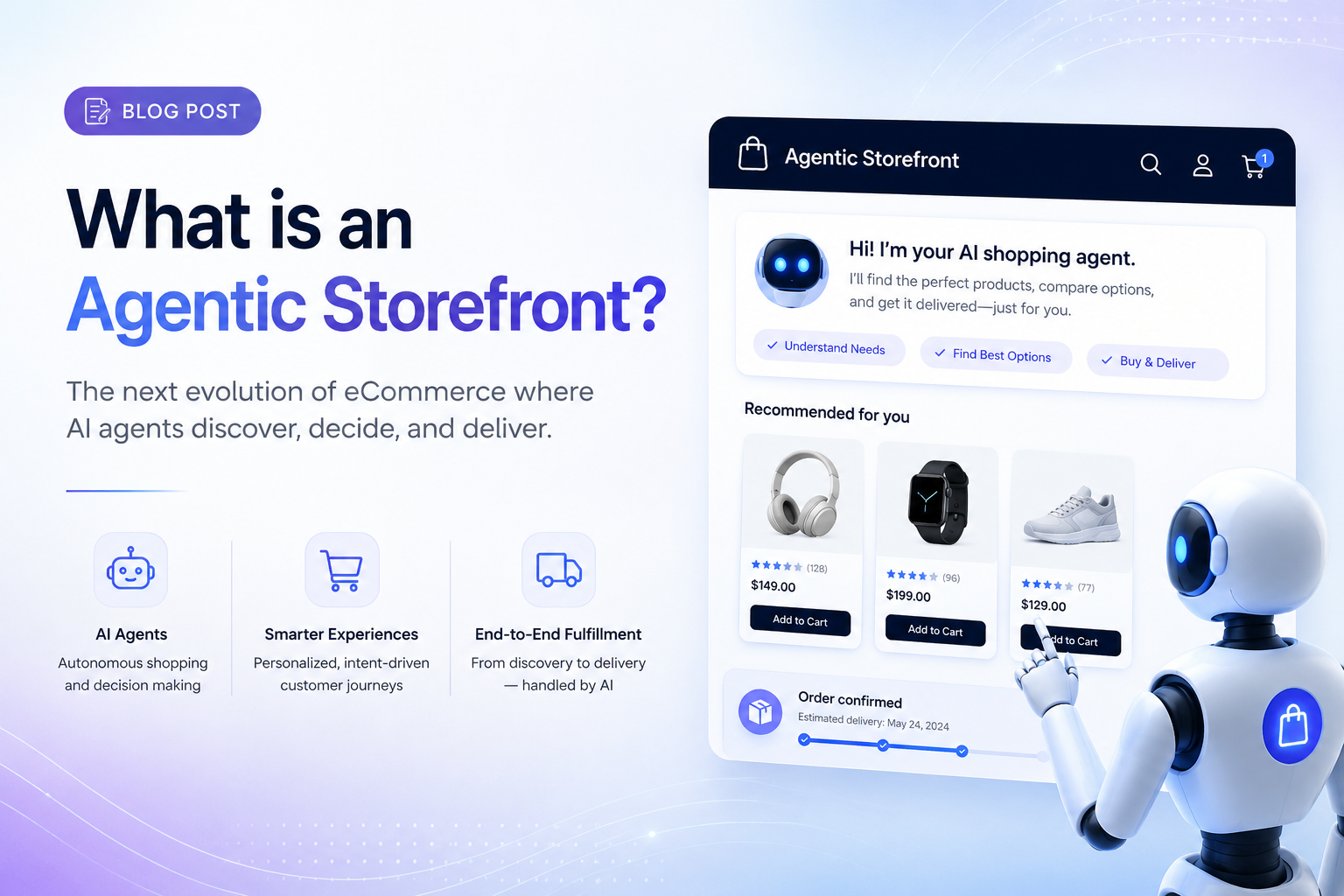
AI assistants now find products, compare prices, and complete purchases for shoppers — without anyone visiting your website. Here is what that means for your store.
Picture this: a customer opens ChatGPT and types, "Find me the best waterproof running shoes under $120." Within seconds, ChatGPT returns five options — with prices, images, and a button to buy. The customer never visits a single website. The purchase happens inside the chat.
That scenario is already happening at scale. Adobe Digital Insights tracked a 4,700% year-over-year increase in AI-driven traffic to retail sites by mid-2025. On Shopify alone, AI-attributed orders grew eleven times between January 2025 and January 2026.
So here is the question every store owner should be asking: how does my store get into that conversation?
The answer is an agentic storefront. This article explains what one is, which protocols power it, which platforms support it today, and what your store needs to do to be ready — regardless of which platform you are on.
Traditional shopping puts your store in the search results and waits for a click. Agentic commerce sends your products directly into AI conversations — where the buying decision is already happening.
What Is an Agentic Storefront?
An agentic storefront is the infrastructure that surfaces your product catalog inside AI platforms and allows customers to discover and buy your products directly from an AI chat interface.
Think of it as a new sales channel — separate from your website, your marketplaces, and your social commerce. Instead of a customer browsing your store, an AI agent does the browsing on their behalf, matches your products to what they asked for, and presents them in the conversation.
This is different from an AI chatbot on your website that answers questions. An agentic storefront is about being discoverable inside ChatGPT, Microsoft Copilot, Google AI Mode, and similar platforms — before the customer has even thought to visit your site.
The agentic shopping journey collapses discovery and purchase into a single AI conversation.
The broader shift here is one called agentic commerce — a model of digital commerce where AI agents research, compare, and select products on behalf of shoppers, completing approved transactions with minimal human intervention. An agentic storefront is how your store participates in that model.
An agentic storefront is not a new website, app, or theme. It is the connection between your product catalog and AI shopping platforms — allowing those platforms to understand, surface, and sell your products on your behalf.
Which AI Channels Are Actually Live Right Now?
Not every AI platform has the same level of agentic commerce capability today. Some allow direct in-chat checkout. Others surface products for discovery and then redirect customers to your site to complete the purchase. Here is an honest look at where things stand as of May 2026.
| AI Channel | Status | Protocol | Checkout type | Access route |
|---|---|---|---|---|
| ChatGPT | ✓ Live | ACP | Instant Checkout via Stripe; or in-app browser redirect to your store | Shopify Catalog — auto-enabled for eligible stores |
| Microsoft Copilot | ✓ Live | ACP | Direct in-chat checkout available | Shopify admin → Settings → Sales Channels toggle |
| Google AI Mode | ✓ Live | UCP | In-agent checkout via Google Pay; publicly available since March 2026 | Shopify UCP endpoint (/api/ucp/mcp) — enabled via admin toggle |
| Gemini | ✓ Live | UCP | In-agent checkout — Gap was first major retailer to launch here | Shopify UCP; Google Merchant Center account required |
| Perplexity | ✓ Live | ACP | Product discovery + merchant site redirect | BigCommerce Surface integration; Shopify Catalog |
| Squarespace / WooCommerce | ~ Partial | ACP | Stripe-powered checkout where configured | Stripe Agentic Commerce Suite — requires manual setup |
| Amazon AI Shopping | ~ In development | — | Not yet available for external merchants | Amazon marketplace sellers only — no external access yet |
One important nuance on ChatGPT: depending on your payment setup, purchases can either complete via Stripe's Instant Checkout — if your store uses Stripe or Shopify Payments — or redirect to your own checkout through an in-app browser. Either way, your site's checkout experience still matters. Speed, trust signals, and mobile performance all affect whether a customer completes the purchase after AI drives the discovery.
Whether a purchase completes inside the AI chat or redirects to your store depends on your payment setup and the channel. Either way, your checkout experience still matters — a slow or mobile-unfriendly checkout loses the sale even when AI drives the discovery.
UCP and ACP: The Two Protocols Behind AI Commerce
Behind the phrase "agentic storefront" there are actually two separate technical protocols operating in parallel. Understanding which one does what will help you make sense of why some channels are available to you and others are not — depending on your platform.
The first is ACP — the Agentic Commerce Protocol, built by OpenAI and Stripe. This is the protocol that powers ChatGPT shopping. It uses Stripe as the payment layer for in-chat checkout, which means it works most cleanly for stores that already use Stripe or Shopify Payments.
The second is UCP — the Universal Commerce Protocol, developed by Google and Shopify. This is what powers Google AI Mode and Gemini. Unlike ACP, UCP is payment-processor agnostic — it works with Shopify Payments, PayPal, Klarna, or any other compatible processor. On Shopify, UCP is accessed through a specific endpoint at /api/ucp/mcp, which is what allows AI agents to query your catalog, check availability, and initiate purchases.
The practical implication: these two protocols share about 80% of the same technical foundation. A store that properly implements one needs only a modest amount of additional effort to support the other. Both are built on the same schema.org product data, real-time inventory, and clean catalog structure — which is exactly what good SEO already requires.
Both protocols require the same technical base: schema.org product data, real-time inventory, structured return and shipping policies, and consistent pricing across sources. A store that properly implements one needs only modest additional effort to support the other.
What can an AI agent actually do with your store?
When people talk about agentic storefronts, they often assume it just means product discovery — a customer asks ChatGPT a question and your product gets mentioned. But the reality is more capable than that. Both UCP and ACP structure agent interactions around distinct capabilities that merchants can enable individually.
AI agents can complete a purchase on behalf of the user — payment-processor agnostic, so it works with Shopify Payments, PayPal, Klarna, and others.
Agents can communicate delivery times, shipping options (standard, express, pickup), and provide real-time order tracking post-purchase.
Agents can discover and apply promotions, promo codes, and loyalty discounts. You control which offers are exposed to agents at any time.
Agents can initiate a return request, generate a return label, and track refund status — all without the customer contacting support.
Agents can save or add multiple items to a basket from a single store, enabling multi-item purchases within one session.
Agents retrieve real-time product details — variants, pricing, inventory — directly from your store, so recommendations always reflect current availability.
Shoppers can carry loyalty points and member benefits across UCP-integrated platforms, enabling a seamless cross-platform buying experience.
[HTML BLOCK 7 — UCP capabilities cards]
Where Does Each Platform Stand?
This is where things get practical. The answer to "does my store have an agentic storefront?" depends almost entirely on which platform you are on. Here is where each one stands today.
The only platform today with both UCP and ACP fully operational. Agentic storefronts were activated by default for eligible stores in March 2026 — no separate integration required per AI channel.
Actively building agentic commerce infrastructure. At Commerce Live 2026, BigCommerce announced distribution across ChatGPT, Gemini, Copilot, Perplexity, PayPal, and Stripe.
No native agentic storefront yet, but Squarespace is a signed partner in Stripe's ACP standard — providing a route into ChatGPT commerce without migrating. UCP (Google AI Mode) is not yet accessible natively.
Shift4shop has not announced native support for either UCP or ACP. Merchants on this platform currently have no built-in route to AI commerce channels on Google or OpenAI's ecosystems.
Shopify is roughly 12 months ahead of BigCommerce and 18 months ahead of Squarespace on agentic commerce. However, both platforms are actively building. The window where Shopify has a meaningful first-mover advantage is real — and it is narrowing.
Should You Switch to Shopify for This?
This is the question most store owners end up asking after learning about agentic storefronts. Here is an honest answer rather than a sales pitch.
The case for moving to Shopify
Shopify is the only platform today where agentic commerce is fully operational across both UCP and ACP, requires no custom development, and covers all major AI channels from a single admin panel. If you are starting a store from scratch in 2026, Shopify gives you the clearest path.
There is also a less obvious option worth knowing about: Shopify's Agentic Plan. This is a plan specifically for merchants who are not on Shopify and do not want to migrate their store. It lets you add your products to Shopify Catalog and sell through agentic storefronts — on ChatGPT, Copilot, Google AI Mode, and other AI channels — without touching your existing Squarespace, WooCommerce, or custom platform. You keep your current website and gain AI channel access through Shopify's infrastructure.
The case for staying where you are
If your store is performing well on BigCommerce or Squarespace, the switching cost — time, money, and operational disruption — is significant. BigCommerce is 6 to 12 months behind Shopify on agentic commerce, not years. Squarespace and WooCommerce have a route via Stripe's ACP standard. For most established merchants, that gap does not justify a full migration.
There is also an important reality check: agentic commerce is still maturing. Both protocols are actively evolving, and capabilities vary by channel and payment setup. The merchants who benefit most right now are those whose product data is clean, complete, and well-structured — and that is true on every platform.
Most stores will not struggle because agentic storefronts are too complex to set up. They will struggle because their product data is not ready. AI channels need catalog clarity, not just a new channel toggle.
The honest verdict
You probably do not need to switch platforms today. You do need to make sure your store is ready when your platform catches up — and that preparation starts with the same thing it always has: a solid SEO and product data foundation.
Agentic storefronts were switched on by default for all eligible Shopify stores in March 2026. That means your products may already be showing up in ChatGPT and Google AI Mode — whether you planned for it or not. Log into Settings → Sales Channels in your Shopify admin and check what is currently active.
What Makes a Store "Agentic-Ready"? The SEO Connection
This is the part most guides skip. They cover the technical toggle steps and move on. However, the toggle is not the hard part.
When AI platforms like ChatGPT and Google AI Mode surface product recommendations, they are not browsing your store the way a human would. They are querying structured product data through the UCP or ACP endpoint, evaluating it against a shopper's criteria, and deciding whether your products are a good match. If your data is vague, incomplete, or inconsistently structured, AI tools will pass over your products in favor of ones they can interpret confidently.
In other words, all the SEO work that helps Google understand your store — clean product titles, complete descriptions, schema markup, fast load times, crawlable pages — also determines whether AI platforms can surface your products effectively. The foundations are the same.
Where most stores fall short
The stores that struggle with agentic readiness almost always have the same underlying problems: product titles that do not describe what the product actually is, descriptions that repeat the title without adding detail, missing GTINs or product attributes, and pages that are difficult for automated systems to parse.
These are also, not coincidentally, the same issues that hold back traditional SEO rankings. Fixing them lifts both at once.
If you're on Shopify: one more layer to check
Shopify merchants have an additional set of actions that directly improve visibility in Google AI Mode through Merchant Center. In March 2026, Google added new data attributes specifically for conversational commerce — these go beyond traditional product feed fields and allow AI agents to answer buyer questions without leaving the chat.
In March 2026, Google added new data attributes in Merchant Center specifically for conversational commerce. These complement your product feed and give AI agents richer information to work with — including structured answers to common product questions, compatible accessories, substitute products to suggest if yours is out of stock, and Direct Offers for high-intent buyers in AI Mode. For UCP-enabled stores, filling these in acts as a multiplier on your agentic visibility.
The UCP and ACP channel toggles sit at the top — but they only work when the foundations below them are solid.
Both UCP and ACP share the same technical foundation: schema.org product data, real-time inventory, consistent pricing, and structured policies. That is 80% of the work — and it is the same work that good SEO already requires. A store that builds this foundation is not just ready for Google. It is ready for ChatGPT, Google AI Mode, Gemini, Copilot, and whatever comes next.
What About AI Search Visibility — Even Without a Channel Toggle?
This is worth flagging for merchants on Squarespace, BigCommerce, or Shift4shop who do not yet have native agentic storefront access.
Even without a platform-level agentic integration, your products can still appear in AI-generated responses through regular web crawling and indexing. If Google can find and understand your product page, then Google's AI Mode and Gemini can potentially surface it too. The same logic applies to Perplexity and other AI search platforms that index the web.
This is sometimes called GEO — Generative Engine Optimization. It is the practice of structuring your content and product pages so that AI-powered search tools cite and recommend them in generated answers. It does not require a platform integration. It requires good SEO.
In other words, the opportunity to appear in AI search results is available to every store owner right now — on every platform. The UCP and ACP toggles accelerate and extend that visibility. They do not replace the organic route for stores that are not yet eligible.
- An agentic storefront is a sales channel that puts your products inside AI conversations — separate from your website, marketplaces, or social channels.
- There are two protocols behind AI commerce: ACP (built by OpenAI and Stripe, powers ChatGPT and Copilot) and UCP (built by Google and Shopify, powers Google AI Mode and Gemini). They are separate standards, but share 80% of the same technical foundation.
- Shopify is the most advanced platform today — the only one with both UCP and ACP fully operational from a single admin panel, covering all major AI channels as of March 2026.
- BigCommerce is actively building toward the same capability. Squarespace and WooCommerce have a partial route via Stripe's ACP. Shift4shop has no native features announced yet.
- Most stores will not fail at agentic commerce because of technical complexity. They will fail because their product data is incomplete — vague titles, missing SKUs, non-standardised attributes, and absent policy pages.
- The same SEO foundations that help you rank on Google also determine whether AI platforms recommend your products. Build the foundation once — it covers all channels.
- Even without a platform integration, stores can appear in AI-generated search results through standard web indexing. Good SEO is already a form of AI commerce readiness.
Is your store ready for AI-driven discovery?
Getting found in ChatGPT and Google AI Mode starts with the same thing Google rankings do — clean product data, proper schema markup, and a well-structured store. That is exactly what we audit at Digitalweb21.
Get a free consultation